
Spain Digital Nomad Visa Requerimiento: Why the UGE Is Rejecting Bank Statements in 2026
 Written by Hoply
If you have received a "requerimiento" on your Spain Digital Nomad Visa application, it means the UGE (Unidad de Grandes Empresas y Colectivos Estratégicos) has found your file incomplete or incorrect and is giving you 10 business days to fix it under Ley 39/2015. So far in 2026, Hoply's legal team has seen a sharp rise in requerimientos tied to one specific issue: bank statements that are not signed, stamped, or notarized. This guide explains what a requerimiento is, why bank statements have become the leading cause, and exactly how to resolve one before your deadline runs out.
Key Takeaways
- A requerimiento is a formal request for additional or corrected documentation, issued under Articles 68 and 73 of Ley 39/2015. You have 10 business days from notification to respond.
- Bank statement issues are currently the most frequent reason for a Digital Nomad Visa requerimiento in Hoply's caseload.
- The UGE now requires bank statements to be signed and stamped by the bank, or notarized, but only if the bank cannot provide a signature and stamp.
- Digital-first banks such as Revolut, and some UK institutions like Barclays, frequently do not sign or stamp statements, which is where most requerimientos originate.
- A compulsa simple (certified copy) issued in Spain has worked in Hoply's own cases, though a manifestación notarial offers stronger evidentiary weight.
- Missing the 10-day deadline means the application is considered withdrawn (desistimiento), not simply delayed.
What Is a Requerimiento in Spain's Immigration Process
A requerimiento de documentación is an official notice from the Spanish administration stating that your submitted file does not meet the requirements to proceed. It is not a rejection. It is a request to correct or complete your application, known in Spanish administrative law as subsanación.
The legal basis is Articles 68 and 73 of Ley 39/2015, de 1 de octubre, del Procedimiento Administrativo Común de las Administraciones Públicas. Article 68 allows the administration to request that an incomplete application be corrected. Article 73 sets the same rule for missing formal requirements during processing. Under Article 22.1.a of the same law, the legal deadline to resolve your case is paused for the entire period between the notification of the requerimiento and your response, so the clock does not simply keep running in your favor while you gather documents.
You will typically receive the requerimiento through Spain's electronic notification system for the UGE-CE, and it must be answered within 10 business days of the day after notification. If you do not respond in time, the file is closed as desistido (withdrawn), and you would need to file a new application from scratch, including the non-refundable Tasa 790-038 fee.
The Most Common Reasons for a Digital Nomad Visa Requerimiento
Requerimientos are not unique to bank statements. In Hoply's experience, the most frequent triggers across Digital Nomad Visa files are:
- Bank statements without a bank signature, stamp, or notarization (currently the leading cause).
- Missing or inconsistent proof that income actually originates from the applicant's remote employer or clients, rather than from unidentified transfers.
- Expired or improperly apostilled police record certificates.
- Employment or client contracts missing the specific clauses the UGE expects, such as explicit consent to remote work from Spain.
- Company registration certificates that do not clearly show the date of incorporation or the nature of the business.
Bank statements stand out because they touch every applicant, employees and self-employed alike, and because banking practices vary enormously between countries and, increasingly, between traditional and digital-first banks.
Why Bank Statement Requerimientos Have Surged in 2026
For much of the Digital Nomad Visa's short history, applicants were told that signing, stamping, or notarizing a bank statement was recommendable but not strictly enforced. That has changed. So far in 2026, Hoply has observed a clear tightening in UGE practice: what used to be a suggestion is now being enforced through requerimientos in practice, both in Hoply's own applications and in cases where applicants used other providers or applied on their own.
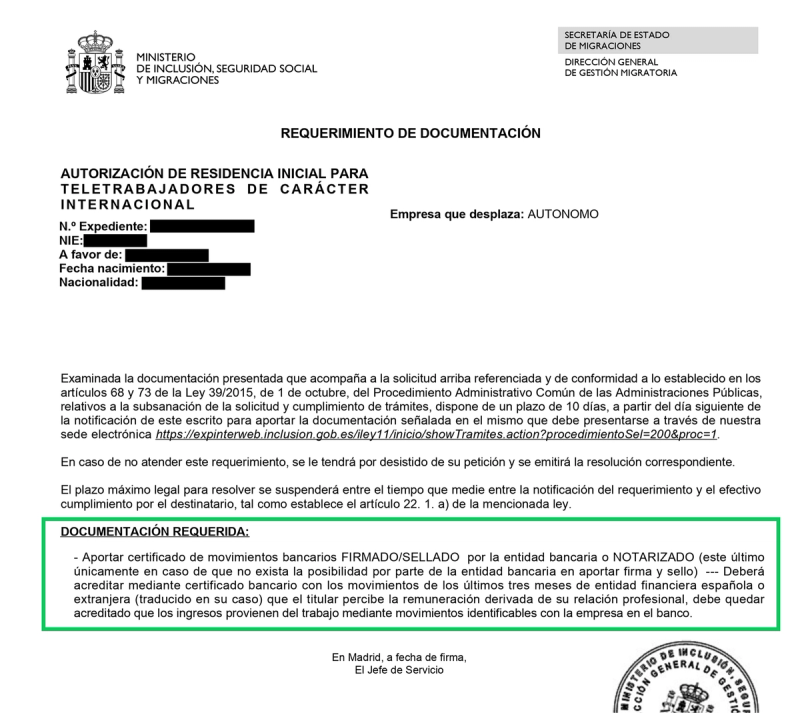
A requerimiento issued by the UGE in 2026 states the requirement in these exact terms:
"Aportar certificado de movimientos bancarios FIRMADO/SELLADO por la entidad bancaria o NOTARIZADO (este último únicamente en caso de que no exista la posibilidad por parte de la entidad bancaria en aportar firma y sello). Deberá acreditar mediante certificado bancario con los movimientos de los últimos tres meses de entidad financiera española o extranjera (traducido en su caso) que el titular percibe la remuneración derivada de su relación profesional, debe quedar acreditado que los ingresos provienen del trabajo mediante movimientos identificables con la empresa en el banco."
In English: the applicant must provide a bank statement, covering the last three months, signed and stamped by the bank, or notarized only if the bank cannot provide a signature and stamp, clearly showing that the deposits are identifiable as coming from the applicant's employer or clients.
This wording matters. Notarization is not presented as the default requirement. It is explicitly a fallback for cases where the bank itself will not sign and stamp the statement. That single distinction is the source of most of the confusion Hoply sees among applicants.
What the UGE Now Requires From Your Bank Statement
To meet this standard, your bank statement should show your bank's signature and official stamp on the document itself, at least three consecutive months of movements before your application date, deposits that are clearly identifiable as coming from your employer or named clients, and a certified translation into Spanish if the original is in another language.
If you can obtain this directly from your bank, no further step is required. The friction almost always comes from banks that are not set up to provide a physical signature and stamp on a downloaded statement.
What to Do If Your Bank Won't Sign or Stamp Your Statement
This is where most 2026 requerimientos originate. Digital-first banks like Revolut, and certain UK accounts such as some Barclays products, are typically built around downloadable PDF statements with no option for a bank officer's signature or stamp. If your bank falls into this category, the UGE's own wording gives you the fallback: notarization.
There are two practical ways to get there, and they are not equally convenient.
Solving It in Spain: Compulsa Simple vs. Manifestación Notarial
| Resolution path | When to use it | Reliability in Hoply's caseload |
|---|---|---|
| Bank signs and stamps the statement | Default option, available at most traditional banks | Fully accepted, no further step needed |
| Compulsa simple with a Spanish notary | Digital-first banks that cannot sign or stamp (Revolut, some Barclays accounts) | Has worked in practice for Hoply's clients |
| Manifestación notarial with a Spanish notary | Same situations as above, recommended over a simple compulsa | Stronger evidentiary value, Hoply's preferred route |
| Notarize in your home country, then apostille | Only when no other option is available | Slowest path, adds a mandatory apostille step |
A compulsa simple is a basic certified copy. A manifestación notarial goes a step further: the notary formally states that the information on the printed document matches what is currently visible on your bank's website or app, which gives immigration officers a stronger, more direct guarantee of authenticity. In Hoply's experience, both routes have been accepted, but the manifestación notarial is the more defensible option when the file is reviewed closely.
Solving It From Your Home Country: Notarization Plus Apostille
Some applicants choose to notarize their bank statement before leaving their home country instead of doing it in Spain. This is technically possible, but it is usually the least convenient path. A document notarized outside Spain will typically also need an apostille under the Hague Convention before it can be submitted, which adds processing time and a second layer of paperwork. If you are already in Spain, or close to applying, resolving this with a Spanish notary is almost always faster.
For a full picture of what document preparation costs across profiles, including translation and apostille estimates, see Hoply's Spain Digital Nomad Visa Cost guide.
Real Example: A 2026 Bank Statement Requerimiento
The requerimiento quoted earlier in this guide is a real notice issued by the UGE in 2026 to an applicant on the self-employed track, with identifying details removed. It illustrates two things clearly: the administration is checking bank statements against declared income line by line, and it is explicitly accepting notarization only where a bank signature and stamp are not possible, not as a first choice. Applicants preparing their financial documentation should read that distinction carefully before assuming notarization is always required, since asking your bank for a signed, stamped statement first can save you an unnecessary trip to the notary.
For the income thresholds these bank statements need to support, see Hoply's Digital Nomad Visa Income Requirements guide.
Received a requerimiento and not sure where to start? Get expert help from Hoply before your deadline.
What Happens If You Miss the 10-Day Deadline
If you do not respond within 10 business days of notification, your file is closed as desistido under Ley 39/2015. This is not a rejection on the merits of your case. It means the administration considers you to have abandoned the request. You would need to start a new application, pay the Tasa 790-038 again, and rebuild your document set, typically adding weeks to months to your timeline. Given how tight the window is, and how specific the UGE's current wording on bank statements is, applicants who are unsure whether their documents will pass are better off getting a second opinion before submitting, not after receiving a requerimiento.
If you are still preparing your application and want to avoid a requerimiento altogether, it is worth having your financial documents reviewed against current UGE practice before you submit. Start your Digital Nomad Visa application with Hoply and have your bank statements checked against the latest requirements before they become a problem.
Frequently Asked Questions
This article is for informational purposes only and does not constitute legal or tax advice. Immigration and tax regulations can change, and each case is different. Always consult a qualified immigration lawyer and tax advisor. Hoply's specialists can review your specific situation.